

Wearables at work: Apple Watch, Garmin, Oura, WHOOP or a company-provided ring?
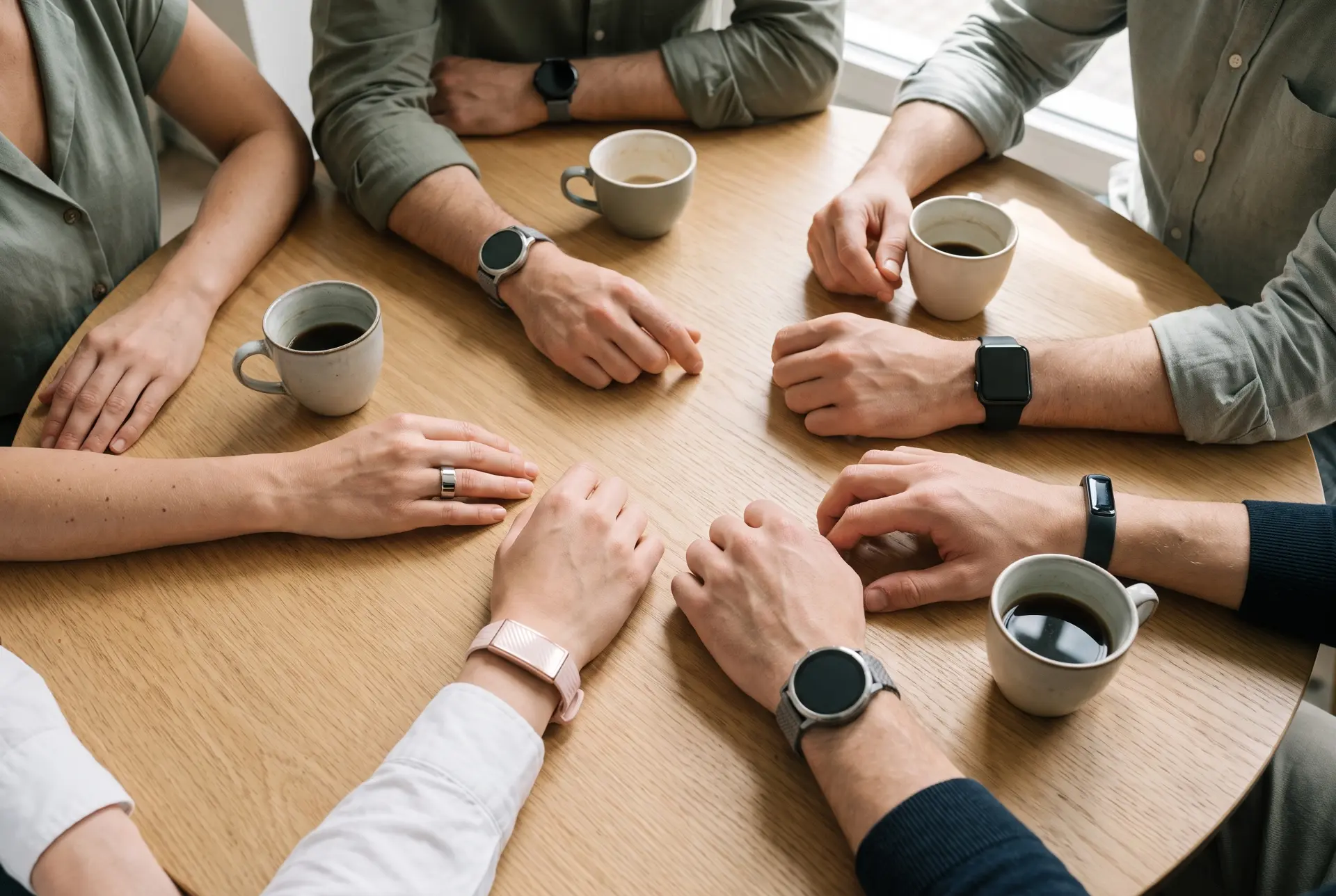
Let people use the wearable they already own and provide a device only to those who have none. Why a device-agnostic platform beats a single brand: adoption, cost, data quality and privacy.
The best answer, almost always, is: all of them. Let people who already own a watch or a ring use it, and provide a device only to those who have none or want it. Tying the programme to one manufacturer costs more, brings fewer people in, and adds a privacy problem you do not need.
Should employees use the devices they already own?
Yes, for two reasons that outweigh any comparison between models.
The first is adoption. A share of your employees already wears an Apple Watch, a Garmin, a Fitbit, a Samsung, a Polar, an Oura or a WHOOP. Asking those people to take it off and put on the “corporate” device is the surest way to lose them on day one.
The second is cost. Every device you do not buy is a cost you do not carry, and in organisations of several thousand people the proportion who already own a wearable is the line that decides the budget.
The condition is that the platform reads all of these devices the same way. Vitality+ integrates Apple Watch, Garmin, Fitbit, Samsung, Polar, Oura, WHOOP and more, and provides the V+ ring and band to people who have nothing: the current list is on the Devices page.
What do watches, rings and bands measure well?
All three families record the same base signals (heart rate, variability, movement, sleep, recovery) but with different habits of use, and it is the habit of use that decides data quality.
Smartwatch. The most common and the most complete for activity and workouts. It has a screen, so people look at it and use it; it needs charging often, and many people charge it overnight. The result: excellent activity data, sometimes no sleep data.
Ring. Discreet, no screen, worn in bed as well. It gives the most consistent sleep coverage, and it is the device many people accept most readily in a work context precisely because it cannot be seen.
Band. Simple and inexpensive, with longer battery life. It covers the base signals and suits people who want a device that asks nothing of them.
There is no best device in the abstract: there is the device a person will keep wearing. For a corporate programme the data that counts is group averages over weeks, and at that level the differences between brands even out.
What about employees who do not have a wearable?
To make the programme accessible to people who do not already own a compatible smartwatch, ring or band, Vitality+ can provide a device to employees who choose to participate. Participation remains entirely voluntary.
This matters because a programme limited to people who already own a wearable may overrepresent employees who are already more engaged with their health and activity. Providing a device to those who do not have one makes participation more inclusive and helps make group-level data more representative of the wider workforce.
Devices can be provided in two ways. During the free 30-day demo, V+ rings and bands are available on loan and returned at the end of the pilot. In the full programme, a device can be assigned to each participating employee who needs one and used for the duration of the programme, depending on the purchasing model selected by the organisation.
This way, employees who already own a compatible wearable can continue using it, while those who do not can participate on the same terms.
How to avoid vendor lock-in with workplace wearables
To avoid being tied to a single manufacturer, the decision should start with the wellbeing platform, not with one specific smartwatch, ring or fitness band.
The key question for any provider is simple: does the platform support the main wearable brands and allow employees to switch devices without leaving the programme?
A device-agnostic platform can integrate wearables from different manufacturers and reduces the risk of vendor lock-in. An employee might, for example, join the programme using their Garmin and later switch to a smart ring or another compatible device without having to start again or move to a different programme.
For the organisation, this creates greater continuity over time. There is no need to standardise the entire workforce on one wearable brand, replace devices whenever technology changes, or renegotiate the programme every time employees’ preferences evolve.
The principle is simple: the wearable can change; the employee wellbeing programme should keep working.
How much does it cost to provide wearables to employees?
The cost depends on how many employees do not already own a compatible wearable and how the organisation chooses to pay for the devices.
With Vitality+, companies can:
Pay for the devices upfront, covering the hardware cost at the start of the programme.
Spread the wearable cost over 3 years, as part of a three-year contract, reducing the initial investment.
Employees who already own a compatible wearable can continue using their own device, further reducing hardware costs.
Privacy: what changes between a personal and a company device?
Less than you might think, if the programme is well built; a great deal, if it is not.
With a personal device the manufacturer account belongs to the person, who authorises the platform to read the data. With a company-provided device there is one question to ask: is the account the person’s or the organisation’s? It must be the person’s. The device can go back to the organisation; the data cannot.
In both cases the same rules apply: voluntary enrolment, individual data visible only to the person, group averages above a threshold for HR. A device handed over by the employer gives the employer no extra rights over the data, and whoever runs the programme should put that in writing before handing it over. In several European countries a tool provided by the employer also has to be assessed against rules on remote monitoring of workers: one more reason why individual data must never reach the organisation.
In short
Use the devices people already own and provide a ring or a band only to those who have none. Choose the platform for how it integrates and normalises brands, not for a single model. A company device gives the employer no extra rights over the data: the account stays with the person.
Related questions
Is a ring better than a smartwatch for measuring sleep? Usually yes, for a practical reason: a ring has no screen and does not need charging every night, so it is worn in bed more consistently. A smartwatch remains better for activity and workouts. For a corporate programme what counts is coverage, not the model.
Does the organisation have to buy a device for everyone? No. Only for people who do not own one and want to join. In large organisations a substantial share already owns a compatible wearable, and that share is what brings the cost of the programme down.
What happens to a company device when someone leaves the programme? The device may either be returned to the organisation or remain with the employee, depending on the arrangement chosen by the company. The data stays with the person and is exported or deleted at their request. The account is never transferred to anyone else.
Want to find the right setup for your organisation? Book a Vitality+ demo and we’ll tailor the programme to your workforce.