

Why Employee Benefits Go Unused and How to Improve Wellbeing Engagement
According to the Great Employee Benefits Study 2026 by Epassi, 35% of surveyed European employees had not used all their available benefits in the previous year (49% in the UK). Why it happens and what HR should measure.
Employee benefits are becoming increasingly sophisticated. Across Europe, companies invest in wellbeing platforms, gym memberships, health programmes and employee rewards.
Yet offering more benefits does not necessarily mean employees are using them.
For large organisations, this creates a challenge: how can companies turn their investment in employee wellbeing into meaningful participation and measurable value?
The European Benefits Utilisation Gap
The Great Employee Benefits Study 2026, conducted by Epassi in collaboration with Pole Star Advisory and researchers from Aalto University School of Business, surveyed 8,000 employees and 3,147 decision-makers across eight European countries.
The findings revealed that 35% of surveyed employees had not used all their available benefits during the previous year. In the United Kingdom, this figure reached 49%.
These percentages refer to incomplete utilisation, not employees who used no benefits at all.
A separate Epassi study published in 2025 reported the following employer-estimated average benefit utilisation rates:
| Country | Average utilisation |
|---|---|
| Finland | 76% |
| Sweden | 66% |
| United Kingdom | 64% |
| Italy | 63% |
| Netherlands | 60% |
| Germany | 56% |
These figures cover employee benefits generally, not exclusively wellbeing programmes, and are based on employer estimates for 2024.
Nevertheless, they highlight an important issue: providing benefits and generating engagement are two different things.
Why Employees Don't Use Their Benefits
Low participation does not necessarily mean employees are uninterested in their wellbeing.
Sometimes the benefits simply do not match their needs.
According to Epassi's 2026 UK findings, among employees who had not used all their benefits, 29% cited insufficient awareness, while 54% indicated that the available benefits did not match their interests.
Traditional programmes can also require additional effort: registering on another platform, booking services or actively seeking support.
For employees with demanding schedules, participation can become another task rather than a natural part of everyday life.
The challenge for HR is therefore not just to communicate benefits more effectively, but to make them accessible, relevant and engaging over time.
The Vitality+ Approach: From Benefits to Everyday Engagement
At Vitality+, we believe wellbeing should be something employees actively experience, not simply another benefit available through a corporate portal.
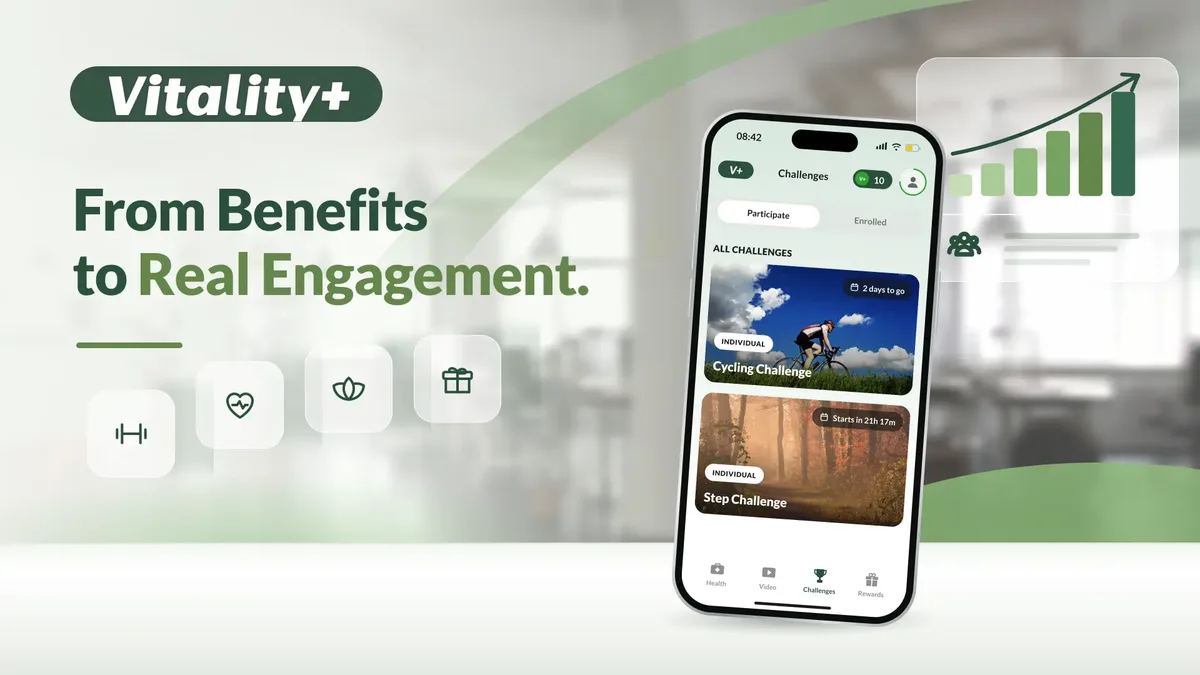
Our platform combines connected wearable technology, personal wellbeing insights, challenges and rewards to encourage ongoing participation.
Employees can connect compatible devices from Apple, Garmin, Fitbit, Samsung, Polar, Oura and WHOOP, or use Vitality+ devices.
Through the platform, they can better understand aspects of their daily wellbeing, including sleep, activity, heart rate and recovery-related indicators.
Our approach focuses on three elements:
1. Personalised Wellbeing
By making personal wellbeing information more accessible, Vitality+ aims to help employees understand their habits and engage more consistently with their health.
2. Challenges and Rewards
Companies can introduce wellbeing challenges that encourage participation and allow employees to earn points towards rewards, including gift cards.
The objective is to make wellbeing more engaging through positive reinforcement and shared activities.
3. Meaningful Insights for HR
Vitality+ complements traditional employee surveys with anonymised, aggregated wellbeing indicators.
This allows organisations to observe group-level patterns, understand participation and make more informed decisions while protecting individual privacy.
These insights support organisational decision-making but do not independently establish the causes of workplace stress or prove improvements in employee health.
Measuring What Really Matters
For companies investing in wellbeing, the number of benefits offered is only one part of the picture.
HR teams should also monitor:
• Activation rate: how many eligible employees begin using the programme.
• Active participation: how many employees engage regularly.
• Retention: whether participation continues over time.
• Challenge engagement: how employees participate in wellbeing initiatives.
• Employee-perceived value: whether employees find the programme useful.
• Wellbeing trends: aggregated indicators that can support organisational analysis.
These measurements can help companies understand what works, identify opportunities for improvement and evaluate their investment.
Importantly, higher engagement does not automatically mean better health outcomes. Participation and wellbeing improvements should be assessed separately.
From Benefits That Exist to Wellbeing That Works
European research shows that employee benefits are not always used to their full potential.
For organisations, the opportunity is not necessarily to spend more, but to make existing and future investments more relevant, engaging and measurable.
Vitality+ addresses this challenge by connecting personal wellbeing awareness, everyday participation, incentives and privacy-conscious organisational insights.
Our ambition is to help companies move beyond simply offering wellbeing programmes towards actively improving how employees engage with them.
Because the real value of a wellbeing benefit is not just in making it available, but in helping people use it to make a meaningful difference in their everyday lives.
Frequently Asked Questions
What is employee benefits utilisation?
Employee benefits utilisation measures how actively employees use the benefits provided by their employer, including participation, activation and service usage.
What is the average employee benefits utilisation rate in Europe?
There is no single universal European average. Epassi's 2025 study reported employer-estimated utilisation rates ranging from 56% in Germany to 76% in Finland across six countries.
How can companies improve wellbeing engagement?
By offering more relevant programmes, simplifying access, encouraging voluntary participation and measuring engagement over time.
How does Vitality+ support employee wellbeing?
Vitality+ combines connected wearables, personal wellbeing insights, challenges, rewards and aggregated organisational reporting to encourage engagement and support informed HR decisions.
Sources
• Epassi: Great Employee Benefits Study 2026
• Epassi: Great Employee Benefits Study 2025 (PDF)
• Epassi: UK Insights 2026
• PIB Employee Benefits / YouGov: Mind the Gap 2026